
What I Read in 2025...so far
Read fiction, I'm begging you READ FICTION

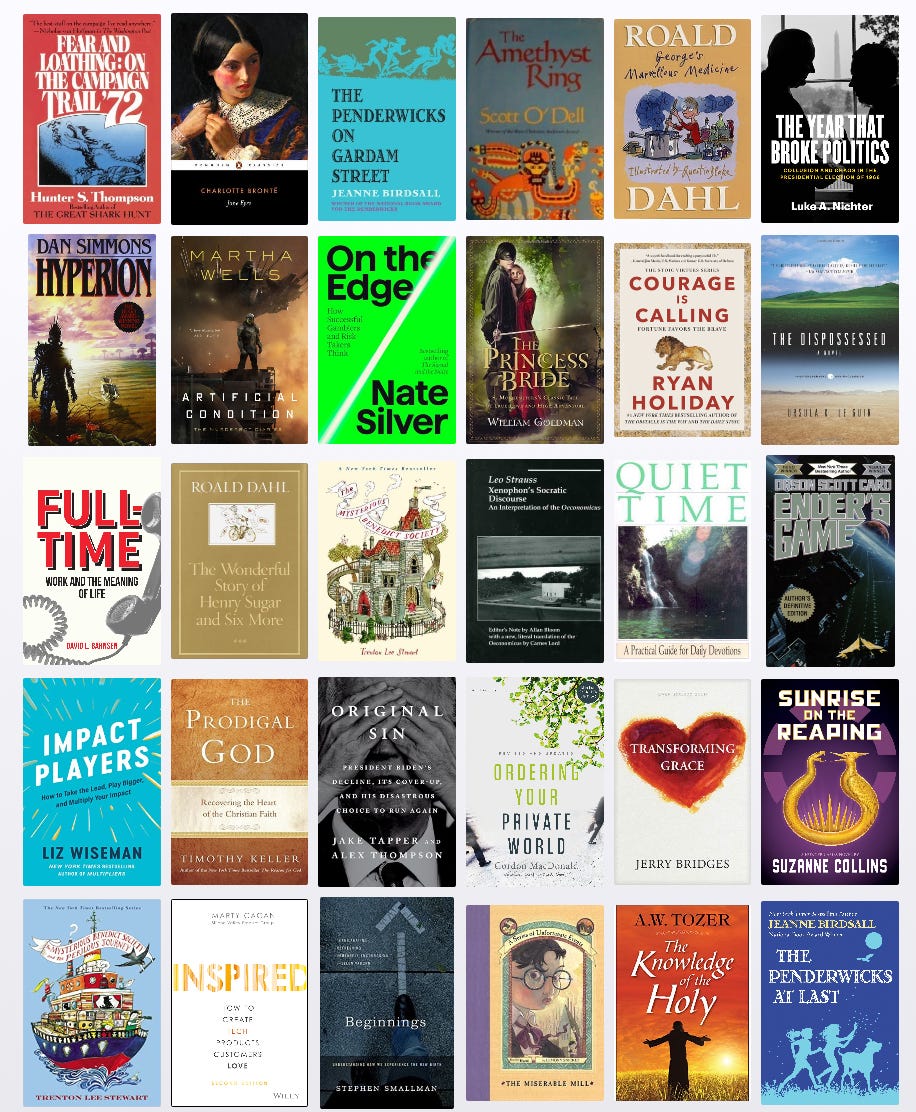
It’s a month later than I intended, but my end-of-year reading post was so well received I wanted to do another one, for the first half of 20251.
As a reminder: I used to read a lot of business books. Now I don’t2.
If you’re looking for recommendations on the latest hot takes in business, leadership, or data books...look somewhere else. I’m sure there are thousands of LinkedIn influencers eager to tell you about whatever book someone paid them to promote.
But if you’re after something a little more eclectic, books that actually stuck with me, plus a few gems I read with my kids, you’re in the right place.
My 2025 so far:
30 Books read/listen
8 with my kids
> 9,000 pages read
And if one of these resonates (or you’ve got a book I need to read) hit reply (or comment below). I’d love to hear what’s stuck with you lately.
The highlights
Jane Eyre by Charlotte Bronte
Oeconomicus by Xenophon
If your job is to lead people, you need to understand people. And that means reading things that survived the filter of time. Both of these have.
I read these as part of a reading group at my kids’ school. One is a 19th-century feminist gothic novel. The other is an ancient Greek dialogue about managing a household. And yet, they both teach more about human nature than any modern business book I’ve read.
That’s the thing about the classics: they endure because they speak to the universal qualities of people. They show you power dynamics, loyalty, pride, insecurity, and self-deception. Not as bullet points, but in action. Forget the frameworks. You need a story that forces you to sit in someone else’s world for a while.
Jane Eyre starts as a coming-of-age story and then gets…weird. Jane begins as an unloved orphan and becomes a confident woman, only to have her entire world collapse. Watching how she rebuilds herself is a masterclass in resilience and conviction. Through her, we also see the men in her life clearly: their pride, their weakness, their self-righteousness, and in at least one case, their redemption.
Oeconomicus is completely different, but it’ll make you think just as much. Written by Xenophon, (one of the few besides Plato to write dialogues featuring Socrates) it covers household management but also paints a picture of virtue, order, and authority as understood in ancient Greece3. I don’t love the dialogue format (and I despise its half-witted corporate derivative, the “business parable”), but this one is readable and surprisingly provocative. At one point, it made someone in our group so mad she threw the book across the room. You’ll also never hear a more intense argument about crop planting.
Ender’s Game by Orson Scott Card
I reread this during my first year as a manager...and I’ve reread it every year since. It’s better than almost any modern business book on leadership. I mean that literally: I’ve taught leadership classes with Ender’s Game as the core text.4
It captures the emotional cost of leadership in a way most business books won’t touch: the stress, the weight of holding other people’s future in your hands, the loneliness of command, and the toll that excellence demands.
You can read a modern book that tells you, “Leadership is hard and lonely.”5 Or you can feel Ender isolate himself from the people he commands, watch him break under pressure, and still lead brilliantly.
The difference between tactics and strategy comes alive in the Battle School. You don’t need a Harvard case study. You need to watch how Ender wins, and at what cost.
Weirdly, it reminds me of The Odyssey. Like Homer, Card gives you a gallery of leadership styles and lets you sit with why one of them (Ender’s) endures. He doesn't tell you. He shows you.
Every time I come back to it, I see something new. My copy is so full of underlines and notes I had to start using different colors for each reading.
On the Edge by Nate Silver
This book is Silver examining the world of risk-taking, specifically in the context of professional poker. But the bigger takeaway for me was Silver’s assertion that most people don’t take enough risk in their professional lives.
That hit hard. Because the most common posture I see from data professionals? Pathological risk aversion. A near-religious devotion to safety, so much so that they won’t even recommend anything. Instead trying to hide behind the data, sheepishly muttering, “That’s what the data says,” as if that somehow absolves them of responsibility.
But this doesn’t work. Not for the company, not for your team, and definitely not for your career.
You can’t improve business decisions if you’re not willing to take risks. Quantifying risk is important. (that’s where data adds value!) But if you’re not recommending any risk, you’re not a partner. You’re an expensive disclaimer no one listens to.
Data teams that avoid risk aren’t respected; they’re eliminated. You can’t build anything meaningful if your main goal is to never screw up. In trying to avoid the possibility of failure, you almost guarantee the appearance of failure (oh, the sweet irony). At best, you’re labeled a cost center. And cost centers get cut.6
And at a personal level, risk avoidance is career sabotage. Every meaningful leap I’ve made in my own work came from a decision that involved real risk: walking away from comfort, security, and predictability. Some of those bets didn’t pay off. But more than once, I’ve left a “safe” job right before the rug got pulled out.
What drives me crazy is how poorly most people estimate risk. So many mid-career professionals think they’re playing it safe by staying in a big company, keeping their heads down, doing “solid work.” But when the layoffs come (and they always do) they’re just as exposed as anyone at a startup. Sometimes more7. The only thing they’ve done is cap their upside.
Real low-risk employment looks like a pensioned government job8. Everything else? You’re still exposed.
So take chances. Give yourself some upside. The worst-case scenario isn’t failure; it’s wasting years avoiding it, and having nothing to show for your caution.
Impact Player by Liz Wiseman
Surprise! A business book!
This one came free with my Wall Street Journal subscription, and it actually held my attention long enough for me to finish it9.
Does it still fall into the usual business book traps? Absolutely.
But it is absolutely useful. Especially early in your career or if you are feeling stuck.
Wiseman breaks down what makes someone an “impact player,” and in my experience, it all rings true. The best people I’ve worked with do these things:
Make yourself useful (aka go where the work actually is)
Know when and how to step up and step back
Finish stronger
Ask and adjust
Make work light
Easier said than done, of course. But it’s a solid map for what real impact looks like.
That said, don’t feel any pressure to read every word. It’s still a business book. Skim it. Jump around. Stop when it stops being useful. No one needs all 563(!) pages. I’ve already given you 80% of the value.
Kid’s Recommendation
The Princess Bride by William Goldman
I read this to my kids after they watched the movie, which led to a very proud father moment:
“But Daddy, it’s frustrating because the book is so much better than the movie.”10
The book is layered, absurd, and wickedly clever in ways the film could never fully capture. Especially with all of Goldman’s fake “editorial commentary” about the parts he cut from the “original manuscript.” It’s satire wrapped in fairy tale wrapped in meta-joke. If you love the movie, the book is richer, weirder, and far more rewarding.
Your kids will need to be a little older to catch the deeper layers (8+ feels like the floor), but it’s one of those rare books they can reread for years and always discover something new (and ridiculous).
The Mysterious Benedict Society by Trenton Lee Stewart
At night, I read book series with my oldest kids. We've made our way through Ramona, Harry Potter, The Penderwicks, and Anne of Green Gables11. The Mysterious Benedict Society is our latest and it’s been a hit.
The setup feels familiar: a group of gifted kids recruited for a secret mission to stop a world-threatening “Emergency.” But the series leans into logic puzzles, wordplay, and emotional nuance. The kids aren’t superheroes. They’re just smart, loyal, and in way over their heads. And they keep trying to do the right thing, even when it’s scary, confusing, or completely unfair.
That’s what makes this such a great read-aloud series: it gives you natural teaching moments about courage, conscience, and what it means to do the right thing when you're terrified.
We’re in the middle of book three (of five). The openings are slow, but once things get moving, there’s real tension, clever twists, and genuinely funny moments. And maybe most importantly: it’s one of those rare kids’ series where the adult reading it doesn’t secretly want to bail halfway through12.
If you want to lead, read fiction. Not optional. Not extra credit. Your job is to understand people, and you won’t get that from case studies on undergrads or frameworks from middle managers turned authors. People aren’t systems to be optimized. Novels and serious biographies give you what technical books can’t: a gut-level understanding of fear, ego, loyalty, and failure.
It feels inefficient. It isn’t.
First half-ish? It may include some book in July
This should go without saying, you cannot judge the people involved by modern standards. There are slaves, men are in charge of everything, and women are married off as teenagers. You need to look beyond the specific situation to find the insights for today
If there’s interest, I may open up a public version of the class.
If they will even admit that
For more details on how you go from loved to cut:

The incentives of layoffs are weird and often perverse. Cheap and inexperienced? Cut. Expensive and experienced? Also cut. And whatever saved you from this round? Might be the reason you’re on the list next time.
OK maybe not as low risk as it used to be.
On and off over 3 years, but it still counts! Like I said, I don’t like reading business books anymore.
Excuse me for a minute, its getting dusty in here
OK, maybe not finished, but the series is like 8 books long
Looking at you, last two Penderwicks books